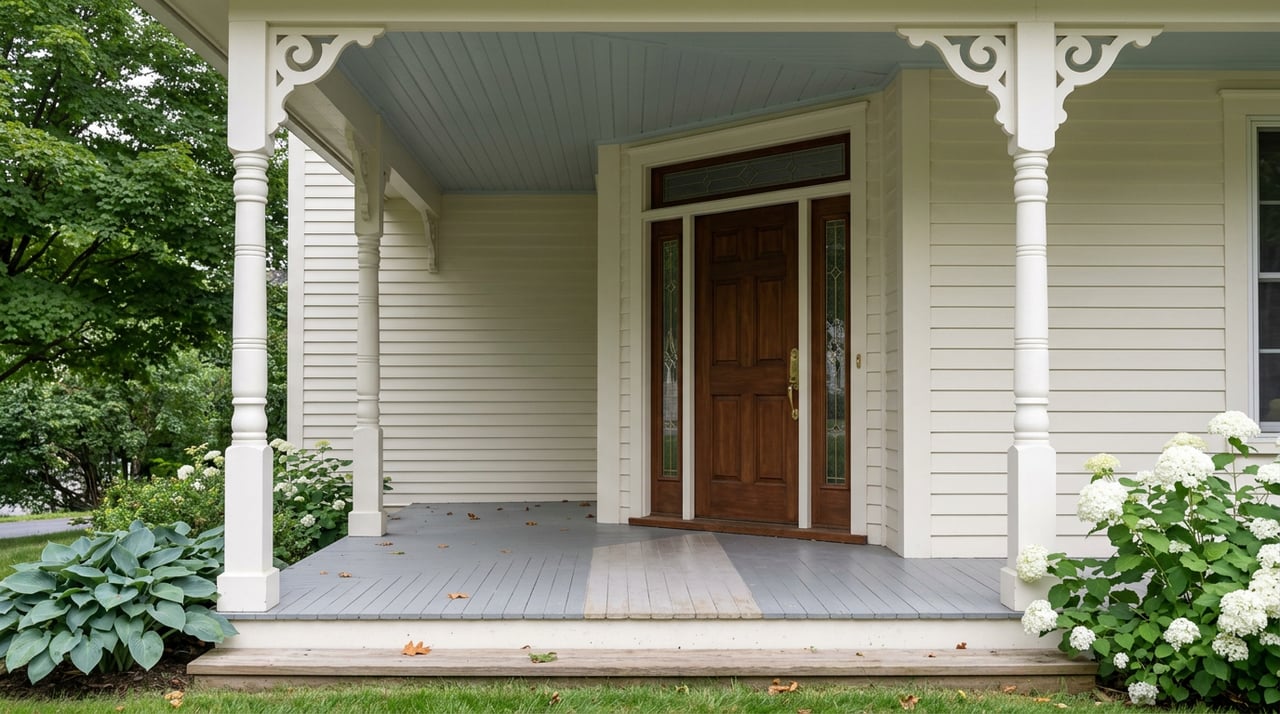
What the Woodstock Square Historic District Actually Requires Before You Renovate
September 10, 2026
September 10, 2026
On June 16, 2025, the Woodstock Historic Preservation Commission opened its monthly meeting with a status update on a home on Hutchins Street. The remodel wasn't finished. The owner had already been cited once, and a second citation had triggered a court date set for July 10, where the city planned to ask for daily fines until the work was brought into compliance. This wasn't a penalty for skipping a building permit. It was for skipping a separate approval that runs alongside the permit for any exterior work inside the Woodstock Square Historic District.
If you're circling one of the Victorians ringing the Square, that second approval is the part no listing photo captures. One home that hit the market this month describes itself in classic real estate shorthand: built in 1910, nine-foot ceilings, original hardwood on the main level, a stained-glass window framing the entry. It reads like exactly the kind of house buyers move to Woodstock for. What it doesn't say anywhere in the listing is that the roof, the siding, the windows, even the paint color on that entry, may already answer to a city commission before you're allowed to touch them.
Woodstock's downtown earned its spot on the National Register of Historic Places in 1982, and the city followed in January 1996 with an ordinance creating the Downtown Business Historic District and establishing the Historic Preservation Commission to oversee it. Shortly after, Woodstock became a Certified Local Government under the National Park Service, a designation that also opens the door to state and federal preservation incentives for owners inside the district.
None of that is decoration. It means that before any exterior alteration begins on a property inside the boundary, from a new roof to a repainted porch rail, the owner needs a Certificate of Appropriateness. The city's own historic preservation page spells out how the review splits into two tracks. Category I work can be approved administratively by staff. Category II work, anything with more visual impact on the streetscape, has to go in front of the commission itself.
A case from the commission's own record shows how this plays out over time and ownership changes. In 2018, a property on Country Club Road received a Category I certificate to replace three second-story windows with fiberglass. By 2024, under new ownership, the same house came back before the commission asking to replace the remaining three windows to match. The approval wasn't automatic just because it matched an earlier decision. It went through review again, because the certificate belongs to the project, not the property, and a new owner inherits the obligation without inheriting the paperwork trail.
The commission's design guidelines don't just gatekeep whether you can do the work. They shape what materials qualify, and that changes the invoice. A standard vinyl siding job elsewhere in McHenry County runs in the range of six to eight dollars a square foot installed. Inside the historic district, homeowners are steered toward materials like James Hardie fiber cement or composite shake products designed to replicate original wood shake or slate, both of which the commission tends to favor because they hold period profiles that vinyl can't replicate. A full siding replacement on a typical Woodstock Victorian, cut to match Italianate trim widths and reveal profiles instead of stock big-box dimensions, commonly lands between $25,000 and $35,000, not because the square footage is unusual but because the custom trim work is.
The same logic applies overhead. Standard architectural shingle is often not what clears review for a house facing the Square. Composite shake products built to mimic historic roofing are the more common approved path, adding cost to a job that would be simpler and cheaper on a house two blocks outside the boundary.
Here's a rough sense of how the two paths diverge for a homeowner planning the same kind of exterior project:
| Step | Outside the district | Inside the historic district |
|---|---|---|
| Permit required | Yes, standard building permit | Yes, plus a Certificate of Appropriateness |
| Review body | Building and Zoning staff | Staff (Category I) or full Commission (Category II) |
| Typical timeline | Days | Days for Category I; a full monthly meeting cycle for Category II |
| Material flexibility | Open market options | Limited to period-appropriate profiles and finishes |
| Cost of exterior materials | Standard market rate | Often 20 to 40 percent higher for custom trim matching |
The Historic Preservation Commission meets once a month, and Category II items go on that agenda. Miss the submission window and a project that could otherwise start next week waits for the following month's meeting instead. For a buyer trying to close a purchase, move in, and get a roof replaced before winter, that calendar matters as much as any inspection contingency.
The same Certified Local Government status that creates the review burden also opens a door most buyers don't know to knock on. Properties that carry local landmark designation or sit in a certified historic district can qualify for a property tax assessment freeze and, in some cases, income tax credits, through the Illinois State Historic Preservation Office's program for owner-occupied historic homes. The freeze isn't automatic. The rehabilitation has to meet a real spending threshold, generally a budget exceeding 25 percent of the property's value, and the benefit only holds for an owner-occupied primary residence. If the home sells during the freeze period, the benefit ends for the next owner unless that owner separately applies.
Woodstock also runs its own Facade Improvement Program, funded through the city's Tax Increment Financing district, offering merit-based financial assistance to property owners making exterior upgrades that support the historic character of the Square. It's not guaranteed money, and it follows its own application guidelines through the Building and Zoning Department, but it's a real offset that a buyer weighing the cost of period-correct siding should know exists before assuming the whole bill lands on them.
As of late August 2026, roughly 18 vintage homes were listed for sale in Woodstock, with a median asking price near $330,000 and an average of 47 days on market. That price reflects the charm, the ceiling height, the walk to the Square. It does not reflect whether the specific parcel sits inside the historic district boundary, and it does not reflect what the first exterior project will cost once the Certificate of Appropriateness enters the picture.
Before writing an offer on a home you already know you want to touch up, it's worth confirming two things. First, whether the parcel actually falls inside the historic district, since the boundary follows specific streets rather than a simple radius around the Square. Second, whether any exterior work the previous owner did already has an approved certificate on file, since an unpermitted change (like the Hutchins Street situation) can become the new owner's problem to resolve, not just the seller's.
If your inspection contingency period is short, it's worth asking your inspector to flag anything that looks like recent exterior work, then checking with the city whether that work has a certificate attached. That single question can save weeks of finding out after closing that a roof or a porch rebuild was never actually approved.
Does every home in Woodstock need a Certificate of Appropriateness? No. The requirement applies specifically to properties inside the Downtown Business Historic District and to individually designated landmark properties. A home a few blocks away with no historic designation follows the standard building permit process only.
Does interior renovation trigger the same review? The Certificate of Appropriateness process governs exterior alterations, new construction, and changes visible from the public way. Interior work generally follows the standard building permit process without HPC review, though it's worth confirming with the Building and Zoning Department for any project that touches load-bearing exterior walls or historic features.
How long does Category II review actually take? Category I items can clear in days through staff review. Category II items wait for the Historic Preservation Commission's next regular meeting, which happens monthly, so timing a project around that calendar matters more than it would for a standard permit.
Buying a home near the Square means buying into a piece of Woodstock's history, and that's part of the appeal for a lot of people who choose this neighborhood over a newer subdivision. It also means the renovation math looks different than it would anywhere else in McHenry County. If you're weighing one of these Victorians and want a clear-eyed read on what a specific address will actually cost to update, Sells The Burbs can walk through the district boundary, the approval timeline, and the real numbers before you write an offer. Let's Connect.
September 17, 2026
September 10, 2026
September 10, 2026
September 3, 2026
August 27, 2026
August 20, 2026
August 13, 2026
August 6, 2026
July 23, 2026
Work with someone who knows McHenry County beyond the listings. Melanie brings a thoughtful, steady approach to every step, helping buyers and sellers feel informed, comfortable, and connected to what comes next. Around here, real estate is less about the transaction and more about finding the right fit for your next chapter.
Sells The Burbs | Melanie Enriquez
230 W Virginia St Crystal Lake IL 60014